










Listeners' Choices
1. Adam Bowen - A quick embrace from some wild horses in the McCullough Peaks range at last light.
Biography - Adam Bowen is a wildlife photographer who has been living in Cody, Wyoming, for the last 2 years, spending his days guiding in Yellowstone. Photography has always been a passion of his, and Wyoming has some of the greatest wildlife he’s ever seen. - Adam Bowen
About the Photo - This photo was taken at the McCullough Peaks Wild Horse Management Area just outside of Cody. He had spent countless hours trying to photograph these wild horses from the “Red Point Band”, and on this particular evening, all the stars had aligned for a great shot!

________________________________________
2. Holly Sandefer - Desert Exhale
Biography: Holly Sandefer was born and raised in Casper and has lived in several places across the great state of Wyoming. She is happiest outdoors—hiking, biking, camping, stargazing, snowshoeing, capturing nature’s beauty, collecting rocks, or simply breathing in the fresh, crisp Wyoming air. To Holly, Wyoming is a true wonderland.
About the Photo: In the vast Wyoming sky, pink hues slip through a window’s reflection on the prairie, a gentle exhale of the day, a simple reminder to breathe, and a hopeful whisper that tomorrow is another new beginning.
Holly's photograph, “Desert Exhale,” was taken in Pinedale, WY, on a peaceful fall evening. She had ventured out to soak in the colors and breathe in the fresh autumn air. As the sun was slowly setting, Holly noticed a striking reflection in the window of a small building nestled in the prairie, with the Wind River Range standing in the background. The contrast in colors caught her eye and made her stop and stare in awe. - Holly Sandefer

________________________________________
3. Davidson Family - Strawberry Hill Dance ~ 1918
About the Photo: “Strawberry Hill Dance – 1918” captures a milestone in the Davidson family’s Wyoming story, rooted in the journey of Even and Astri Lee, who immigrated from Norway in 1877 and 1887, respectively. After marrying in Willow, ND, in 1888 and raising three children, the couple moved to Crook County in 1917, where their two sons homesteaded side by side.
The dance shown here celebrated the completion of eldest son Ole Lee’s cabin in 1918 — a classic moment of community cheer. Ole later married Allegra Nemetz in 1923, and their daughter Ruth, born in this very cabin in 1924, carried the family legacy forward when she married fellow Crook County native Stanley Davidson. Their son, Keith, continued the lineage, raising four children and later welcoming five grandchildren — Even and Astri’s 3x great-grandchildren. More than a century after this dance, much of the original cabin still stands on the homestead and remains in the hands of the Davidson family, who were honored with the Wyoming SHPO Centennial Farm & Ranch designation in 2017. The photograph represents not only a celebration in 1918, but the enduring connection of six generations to the land that became their home. - History of the Davidson Family

________________________________________
4. Phil Hilson - Echoes of Earth and History. Heart Mountain has a dual history of an Ancient landslide and a WWII Internment camp.
Biography: Phil Hilson is a retired professional violinist and orchestra teacher who has transformed his lifelong dedication to the arts into a celebrated photographic journey. Now based in Cody, Wyoming, he turns his lens toward the wild and the timeless — the soaring grace of hawks, the glow of distant nebulae, and the rugged drama of the American West. With the trained eye of a performer and the heart of a storyteller, Hilson seeks the places where beauty and meaning overlap. His images are crafted with patience, skill, and a deep respect for the landscapes and wildlife that define Wyoming’s character. Whether tracking a grizzly across sagebrush country or revealing interstellar wonders invisible to the naked eye, his photography invites viewers to feel a moment rather than simply look at it.
Hilson’s award-winning work has been recognized by Wyoming Wildlife Magazine, the Cody Art League, and Wyoming Public Media. His art reflects the essence of his adopted home — powerful nature, layered history, and the resilience of those shaped by both.
Through his photography, he hopes to remind others of a simple truth: There is always more to see… and more to remember.
About the Photo: Golden wildflowers ripple across the Wyoming plains like sunlight poured onto the land. Above them rises Heart Mountain — steadfast, commanding, unforgettable. It's very summit is a monument to Earth’s power: a colossal block of ancient limestone that slid miles from the Absaroka volcanic plateau in what scientists consider the largest known landslide on land. An event so immense that it reshaped the very story of this mountain.
But Heart Mountain holds human history, too. In its imposing shadow once stood the Heart Mountain Relocation Center, where thousands of Japanese American citizens and immigrants — families, children, veterans — were forced to live behind barbed wire during World War II. Their lives uprooted, their freedom temporarily stolen, even as the mountain remained unchanged.
This photograph embraces these two truths. The land itself is an echo of upheaval and survival. The history beneath it is an echo of resilience and remembrance. The flowers bloom freely today, a reminder that life continues. Yet the mountain asks us not to forget what has been endured here — by stone, by earth, by people. Beauty and memory coexist in this place.
Heart Mountain is not only seen — it is felt. - Phil Hilson

________________________________________
5. Mary Whalen - October 2025 - Enjoying the Wyoming Traffic
Biography: Mary Whalen has lived all her life in Wyoming, including Cheyenne, Sheridan, and Laramie as a student at the University of Wyoming. She considers every day in Wyoming a photo worthy moment. Mary is the vice president of WyoPoets, and encourages others to write and think creatively. In her winning photograph, she remembers the poem, The Road Not Taken by Robert Frost. “Two roads diverged in a wood, and I took the one less traveled by. And that has made all the difference.”
About the Photo: “Enjoying Wyoming Traffic” was taken near Savery, Wyoming- near Battle Mountain and the Continental Divide. This southern region of Wyoming is especially photogenic in autumn. - Mary Whalen

________________________________________
6. Rose Fry - Reenactment of the Battle of Hundred in the Hand at Ft Fetterman
Biography: Rose Fry is a state retiree who now has the time to wander and take photos. She enjoys rising early in the morning, getting in her car, and traveling in whatever direction she feels at that moment. She always finds something, whichever way she goes. Rose also enjoys Wyoming history. There are endless possibilities to find historical spots around Wyoming.
About the Photo: This photo was taken at the reenactment of the Battle of the Hundred in the Hand, which was also known as the Fetterman Fight. The actual battle took place in December of 1866. The reenactment was held in April and put on by the Wyoming State Parks and the Fort Phil Kearny Bozeman Trail Association at the Fort Phil Kearny State Historic Site. "The "Fetterman fight" took place in the Crow Indian treaty guaranteed land, where the Lakotas and their Indian allies were without consent from the Crows. All 81 men under the direction of Captain William Fetterman died. " - Rose Fry

________________________________________
7. Chad Coppess - Sacred eagle wings surround the sacred tower of stone.
Biography: Chad Coppess spent 28 years as the official photographer for the South Dakota Department of Tourism, but sneaks over the border and spends as much time in Wyoming as he can. His interest in Old West and Native American history pulls him west quite often, and even more so now that he's retired from a second career with South Dakota Magazine. A new aspect of his photography is placing Western action figures into actual historic locations, which, of course, means pretty much all of Wyoming.
About the Photo: Ojibwe dancer/artist Michelle Reed jumped at the chance to do a photo shoot at the sacred Mato Tipila, or Devils Tower. The gracefulness of her eagle wings and movement instantly made Chad think of the many birds he's seen circling the tower each time he visits there.
Several tribal legends explain the significance of the Tower to their heritage, many including a gigantic bear that clawed the sides of the rock to create the vertical cracks in its face. The Tower is popular with rock climbers, but a voluntary climbing closure for the month of June respects the cultural and spiritual significance of the monument. - Chad Coppess

________________________________________
8. McKenzy Ellisen - Under the Lights in Meeteetse, Wyoming.
Biography: McKenzy grew up in Seattle, where she first learned photography in a darkroom before moving into digital work. At 19 she relocated to Wyoming and began photographing local brandings and gathers. She’s driven by a passion for preserving the western lifestyle, from the energy of rodeos to quiet moments beneath the northern lights.
About the Photo: Under the Lights was taken on a whim. The subject, Quannah, and McKenzy, rode to the top of a hill on Hoggs Black Diamond Ranch in Meeteetse. After taking in the lights for a few minutes, they got to work. McKenzy lay on the ground, and Q tried to keep the horses as still as possible while McKenzy took photos. Out of 104 photos that she took that evening, this was one of three that turned out. Even cowboys get to enjoy the Northern Lights every once in a while. - McKenzy Ellisen

________________________________________
9. Dave Otto - A Wyoming Memory
Biography: David Otto is a fourth-generation rancher and works for the Natural Resources Conservation Service. His ranch, where David, his wife Ellen, and his mother Nancy reside, is located southwest of Yoder, Wyoming, and is nearly 120 years old!
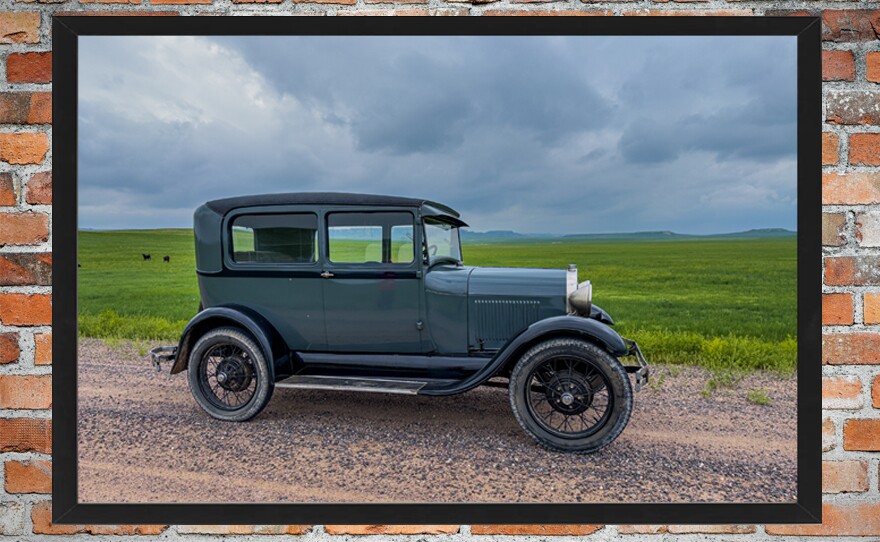
About the Photo: The photo is of his wife’s 1929 Model A Ford that belonged to her great uncle. When her mother passed away, she saw it in a photo and was able to track it down. She was able to return it to her family along with their 1924 Model TT truck, which she has worked to restore. This photo was taken with their ranch in the background. - David Otto

________________________________________
10. Yuki Goto - A New Beginning statue in front of the Cheyenne Depot Museum (Station Pick)
Biography: Yuki Goto moved from Japan to Laramie, Wyoming, in 2024. I work primarily as a web developer and designer, and I am currently taking ESL classes at LLLC to improve my English skills. From a Japanese perspective, Wyoming is not very well known and is often considered a minor state. However, since coming here, I have truly enjoyed learning not only about American history, but also about the unique and meaningful history of Wyoming.
About the Photo: This photo captures a statue gifted to the citizens of Cheyenne to commemorate Wyoming as the first state to grant women the right to vote. Rather than viewing the statue from the front, I took the photo from the statue’s eye level. From this perspective, the Wyoming State Capitol comes into view. Although the statue honors women’s suffrage, the title, A New Beginning, stood out to me. When I saw the title and imagined the view from the woman’s eyes, I felt that granting voting rights represented a new future filled with hope and opportunity for everyone. For me, moving from Japan to Wyoming also represents a personal new beginning. I wondered what this woman might have been looking toward. Hope, responsibility, or a bright future. As I took this photo, I felt a strong connection to that idea and hoped to walk forward into my own new beginning, just as she seemed to be doing. - Yuki Goto

________________________________________
11. Hongjin Li - At dawn, a herd of bison moves through the misted river, their shapes dissolving into light and steam.
Biography: Hongjin Li is a musician and film composer based in New York City. Outside of music, she is an avid outdoor person and wildlife lover. She leads a small expedition caravan called H&F (Hongjin & Friends), dedicated to exploring the U.S. in depth and fostering cultural exchange through travel, sound, and images! This photo was taken during their 12-day Wyoming Cultural Trip, which was both their sixth expedition and the one-year anniversary of H&F!
About the Photo: The photo was taken in August, before the sunrise in Yellowstone’s Hayden Valley, a herd of American bison crossed the river through morning steam. The rising mist caught the first light, turning the valley into a moving tapestry of gold and breath—a quiet moment of wilderness awakening. For the photographer, this image is about the everyday life of Yellowstone—animals and landscapes that have been here long before us—reminding us that we are guests in their habitat and that conservation is an ongoing responsibility.
In their quiet passage lies the continuity of the wild — an unbroken rhythm that has pulsed across Wyoming for centuries. Each step recalls the echoes of the frontier, when survival and freedom were one and the same. Here, the land does not merely remember its past; it speaks it. In this moment, nature is history — alive, breathing, and eternal. - Honglin Li

________________________________________
12. Shane Epping - Where storms break, and rainbows rise.
Biography: Shane Epping teaches at the University of Wyoming, where he occupies the Bobby Model Photojournalism Professorship. Before earning a PhD and entering academia, he worked for a decade as a photojournalist, with his name appearing in The New York Times, The Washington Post, and The Wall Street Journal. His photographs have been exhibited in galleries across America, totaling 10 states in the past four years.
About the Photo: Shane has driven Highway 287 between Fort Collins and Laramie countless times over the past five years. What began as a commute has become a sustained photographic project. This image, made near the state line in September 2024, captures a rainbow emerging from a passing storm as late afternoon sun illuminates the high plains. Rainbows have long symbolized promise, transition, and the fleeting, which are all fitting for a photograph made while in motion, on a road that connects two places the photographer calls home. It's a scene that could only happen in Wyoming, where the land is vast, and the sky is dramatic. The commute, like the rainbow, is transient; the photograph is what remains.
Wyoming’s wide horizons reflect a legacy of resilience and vision. From pioneering women’s suffrage to innovations in energy and agriculture, the Equality State has shaped ranching culture, Native traditions, and western heritage in America. - Shane Epping

History Choices:
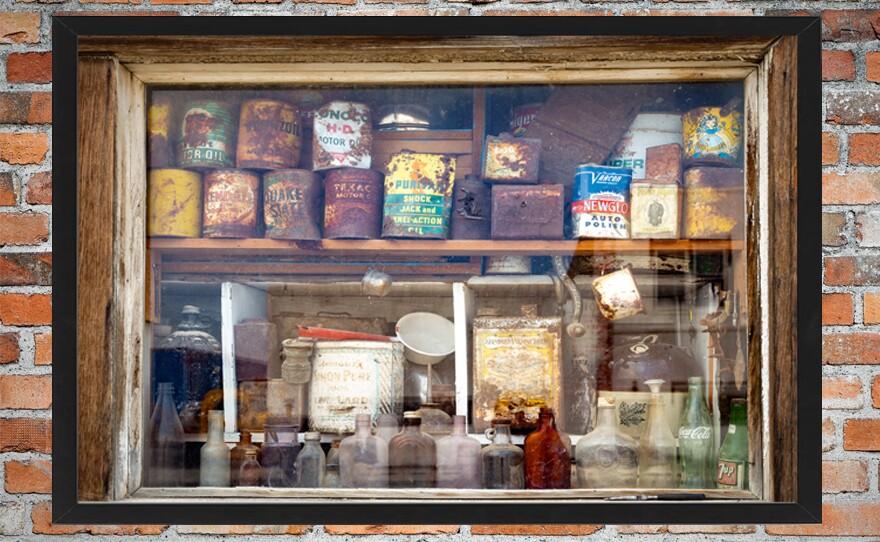
WPM 1. Denise Hawkins - Bottles and tins from years gone by line the storefront window of an abandoned building in Shoshoni, Wyoming.
Biography: Denise Hawkins is a Cheyenne-based photographer and artist. Her work is focused on landscapes, nature, and abandoned places. Her interest in documenting abandoned places has led to volunteer work for the Alliance for Historic Wyoming.
About the Photo: “Storefront Window” was taken in Shoshoni, Wyoming. Unlike the now-demolished buildings on the east side of Main Street, which were taken down in 2018 after fire and neglect left them vacant for over 30 years, the buildings on the west side of the street, including this store, are still standing. - Denise Hawkins

________________________________________
WPM 2. Michael Evans- Old Bedlam at Fort Laramie National Historic Site.
Biography: Michael Evans lives near Veteran, Wyoming, with his wife Joyce and 3 cats. From time to time he fixes fence and takes photos of things.
About the Photo: The photo was taken at sunrise on an October morning at Fort Laramie National Historic Site. At the time, Michael was working for the Park Service and making the morning rounds.
Old Bedlam, the oldest remaining building in Wyoming, was built in 1849, right after the US Army bought Fort John from the American Fur Company. It was the bachelor officer quarters for many years but served different functions, including post headquarters. The building, maintained by the National Park Service, preserves the building as it appeared from 1852-1868. The early rays of the sun at that time of year reflect off the windows and perhaps looks like all the lamps were lit for a party. Today, the rooms are set up to interpret how they may have appeared at various times in the history of US Army occupation, from 1849 to 1890. - Michael Evans

________________________________________
WPM 3. Becky Brock - Florence W. Roginson
Biography: As one of Florence's 12 grandchildren, Becky is passionate about family history and has published numerous books about Florence and related family history.
She has researched and published numerous books focused on Florence and other family members. She retired after a 31-year career including amazing locations with the National Park Service at Natural Bridges National Monument in Utah; Mesa Verde National Park, Colorado.; Ellis Island and Statue of Liberty National Monument in New York City; Katmai National Park and Preserve, Alaska; Lake Clark National Park and Preserve, Alaska.
About the Photo: This photo was taken in October 1919, at the Jake and Carrie Webster ranch located on the Wood River about 10 miles from Meeteetse, WY, where the Wood River branches off from the Greybull River. The nearest post office was Sunshine, WY.
Florence is seen perched on the Webster ranch corral fence wearing men’s clothing (chaps, shirt, and cowboy hat). She and one of the Webster ranch’s hired men, Pete Zocterman, traded clothes for a fun photo shoot on that day.
Florence boarded with the Websters during the 1919-1920 school year. She walked three miles each day to the rural schoolhouse where she taught multiple grade levels during that year.
Per Florence’s letter dated September 16, 1919, her description of the Webster Ranch was:
“They are evidently wealthy ranchers. Have the most adorable log house, but with a lighting system installed & running water! It’s the most attractive house.”
The photo was taken using Florence’s 1918 Vest Pocket Autograph Kodak Eastman camera, which she purchased in London, England, in December 1918, when she served there in the Canteen Girls.
Historical Context: Florence W. Roginson (12/12/1889-11/21/1971) was born in Chicago and grew up in the Buffalo, NY, area. After serving as a WWI Canteen Girl in England and France (October 1918 to August 1919), and at the urging of the “boys” she met overseas, she secured a one-room school teacher job near Meeteetse, Wyoming, for the 1919-1920 school year.
She left Buffalo, NY, in September 1919, and traveled by train to Cody, Wyoming, then by “stage” (pickup truck) to Meeteetse, and then another 10 miles up the Greybull River and finally up the Wood River to her final destination, the Jake and Carrie Webster ranch. She boarded at the Webster ranch and walked three miles each day to the country schoolhouse.
Specific to her 1919-1920 school-teaching year near Meeteetse, WY, Florence was a prolific letter writer to her brother in Buffalo, NY. She vividly described her opinions and astonishment about everything “western”.
Initially, Florence was uncertain she made a wise decision to teach in a rural setting given the remoteness, rugged landscape, and three-mile walk to the schoolhouse. But soon her letters expressed how much she grew to enjoy her surroundings, the people, and the place. Her letters include plenty of drama, hard work, delightful descriptions about ranch life, extreme weather conditions, dances, and the challenges of rural school teaching.

________________________________________
WPM 4 - Jessica Flock - John Wesley Powell Monument in moonlight.
Biography: Jessica Flock was raised in Laramie, WY. Growing up, she traveled the state for swim meets, horse-pack trips, field trips, and rafting adventures. During those experiences, Jessica fell in love with the landscape, history, and people of Wyoming. Her latest adventures include documenting the murals, monuments, and memorials in Wyoming’s 99 Incorporated Municipalities, 104 Census-Designated Places (CDPs), and 55 Unincorporated Communities. In 2019, Jessica was part of the Sesquicentennial Colorado River Exploring Expedition (SCREE / Powell 150), which re-traced the river journey of John Wesley Powell and his men down the Green and Colorado Rivers in 1869. The Powell 150 expedition floated the river for 70 days, hosted numerous outreach events, curated a multi-city art exhibition, and fostered much dialogue about water in the West. When she's not on the river, you may find her in downtown Laramie with her husband and three dogs operating a small outdoor recreation business.
About the Photo: As Jessica was traveling home from Salt Lake City, she liked the way the moonlight was shining upon the Wyoming landscape and thought it might be lighting up the murals and Powell monument in downtown Green River, WY, thus she took a quick detour off the Interstate. John Wesley Powell is remembered for numerous expeditions of the American West in the 1860s and 1870s, most notably his Colorado River Exploring Expeditions of 1869 and 1871. The explorers launched from Expedition Island on the Green River when Wyoming was still a Territory. The sculpture of Powell is on the grounds of the Sweetwater County Historical Museum. Inside the museum, there is a wonderful exhibit about John Wesley Powell and his impact on water in the West. Nationally renowned sculptor David Alan Clark, who grew up in Green River and resides in Lander, WY, created the monument. Photo of "John Wesley Powell Monument in Moonlight" taken on Sept.8, 2022. - Jessica Flock

________________________________________
Holiday Card Choice:
WPM 5- Alirza Orujov – White
Biography: Alirza is a senior Chemical Engineering PhD student at the University of Wyoming and an international student. He loves nature and the outdoors and feels lucky to be in Wyoming, where he can occasionally capture some of the best nature photos.
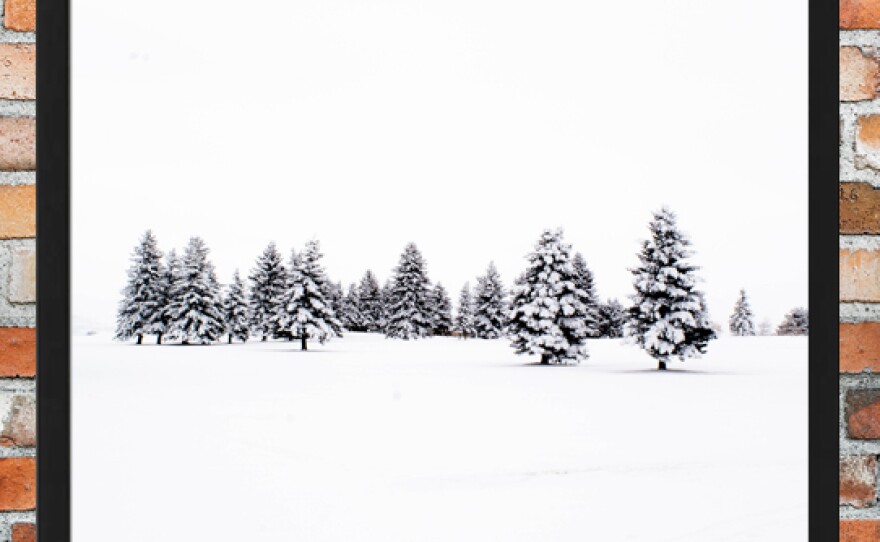
About the Photo: This photo was taken in early February 2022 at Jacoby Golf Course in Laramie. It was Alirza's first winter in Wyoming, and he was excited to explore and take pictures with his new camera. He managed to capture this beautiful moment during a snowstorm after a long walk. - Alirza Orujov

________________________________________
View the many other submissions on the Wyoming’s History Through Listeners’ Eyes Photo Gallery!


