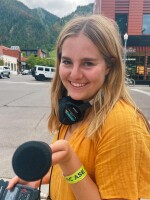
Melissa Dalley quit her dream job working for the National Park Service in April. By July, she arrived in Grand Teton National Park with printouts of a sign the park removed over its winter closure.
Handing them out to the public was the first activity on her list. Sightseeing is secondary on one of many stops of her “anti-censorship” tour, which has already made national headlines.
At an exhibit on the park’s early founders, the former park ranger approached visitors with an objective.
“If they don’t want you to see the sign, I will show you the sign,” Dalley said to onlookers at the Craig Thomas Discovery and Visitor Center.
The removed sign was an addendum to an exhibit on park surveyor Gustavus Cheyney Doane, whose writings helped establish Yellowstone and Grand Teton. It mentioned Doane’s participation in the U.S. Army’s 19th-century massacre of nearly 200 Blackfeet people, something he boasted about the rest of his life.

Grappling with both sides of his legacy, it asked visitors: “How can we acknowledge the good and bad of a historic figure?”
After a career pivot four years ago, Dalley started giving tours at the Martin Van Buren National Historic Site in Upstate New York. In 2025, she survived the cuts to 25% of NPS staff during the 2025 ‘DOGE’ audits.
Within a few months, a federal order directed staff to flag and remove signs and exhibits that are “negative about either past or living Americans,” which the public was invited to help sniff out. In June, a federal judge in Massachusetts ruled that all signs be restored, a ruling that did not hold.
Over a year-and-a-half of sweeping changes, watching federal higher-ups remove mentions of climate science, violence against tribes or slavery was her last straw.
With a jam-packed tote bag and her 13-year-old nephew in tow, Dalley spent her first morning in Grand Teton passing out copies of the removed sign and swearing in what they called “junior resistance rangers,” a spoof on a popular youth park program. Dalley’s also a member of the Resistance Rangers group, an advocacy group made up of former and off-duty park staff.
“I’m living what I’m asking people to do,” Dalley said of her summer
road trip, which includes stops in Yellowstone and Glacier National Parks. The latter removed signs on climate science and a massacre of the Piegan people.
“Being here is kind of like a pilgrimage,” she said.
Grand Teton isn’t alone in losing a sign. A leaked database and a watchdog effort from university librarians together estimate hundreds of signs have been flagged or removed. After quitting, Dalley co-founded America 433 with a similar mission of preserving the missing signage.
A spreadsheet of flagged materials across several national parks, sites and monuments in the Mountain West shows that a Grand Teton exhibit was listed under “non-conformance,” on Sept. 1, 2025. In July, the park confirmed the sign’s non-compliance to KHOL.
Initially, in January, an Interior Department spokesperson denied ties to the order and told the Jackson Hole News&Guide that the removal was part of “routine sign maintenance.”
Not everyone agrees sign removal means censorship is at stake, including Teton County resident Rob Wallace, former assistant Secretary of the Interior for Fish and Wildlife and Parks under the first Trump administration.
“As far as I know, with all the signs in both Yellowstone and Grand Teton National Park, this is the only sign that was taken down,” Wallace said. “It’s not a widespread epidemic of censorship.”

He said he trusts that park leadership follows its processes to remove or add signage, adding that the Doane sign was an add-on to a previous exhibit. Government committees oversee the curation of exhibits, which he believes is the proper forum for those debates.
“Somebody made a political decision to add that sentence about Gustavus [Cheyney] Doane to the sign in the first place,” Wallace said.
Like Dalley, members of the tribe Doane attacked are speaking out against the removed sign, including Tom Rodgers. He successfully lobbied Congress to rename Mount Doane in Yellowstone to First Peoples Mountain in 2022. Rodgers, an enrolled member of the Blackfeet Nation, is well-known in Washington for his work on behalf of various tribes.
He said the effort to remove signs comes across as an attempt to “make America feel good.
“Well, America, sometimes you shouldn’t feel good,” said Rodgers, whose Blackfeet name is One Who Rides his Horse East. “Because your ancestors did horrific things.”
He believes shying away from the past doesn’t allow the country to heal.
If a visitor asks about sign removals, park staff are instructed to stick to “talking points,” according to a memo reviewed by KHOL.
Those instruct staff to “answer truthfully,” which the NPS Office of Public Affairs confirmed in an email. Park staff could deny awareness of the sign changes or cite non-compliance with the federal order, according to the memo.
But Dalley still feels those instructions could contradict each other.
“I felt I wasn’t able to be honest with visitors anymore,” the 49-year-old told KHOL.
Back at the visitor center, most people seem to take Dalley’s mission well. Some thank her for bringing the sign to their attention, like Amy Simon. As an associate professor at Michigan State University, she frequently debates “history erasures” in her college classroom where she teaches about Nazi Germany.
“I definitely think that we miss out when we don’t consider the complicated pasts that we have as a country,” Simon said. “We can be complicated and great all at the same time. We have to hold all of the things together.”
Dalley said she fears the country is losing its ability to access that complicated past.
“Hopefully,” she said to another tourist as she handed out a sign, “you’ll be able to make up your own mind about history, so you have the full story.”